July 3rd, 2010 by dario
New to AcademicProductivity.com?
Here are a few posts that other readers recommend you check out:
[dismiss]
 Donald Knuth announced he would make an earthshaking announcement at TUG 2010. The breaking news is the plan to release the next-generation TeX engine. Read the comments and a brief summary of the announcement in perfect Stevenote style from Slashdot.
Posted in Software, Writing | 3 Comments » | 10681 views
June 12th, 2010 by jose
Using HTML5 features, this is the kind of obvious tool that makes symbol lookup faster than doing it by hand.
Just draw the symbol in the box and up comes the LaTeX code, and the package name that contains it.
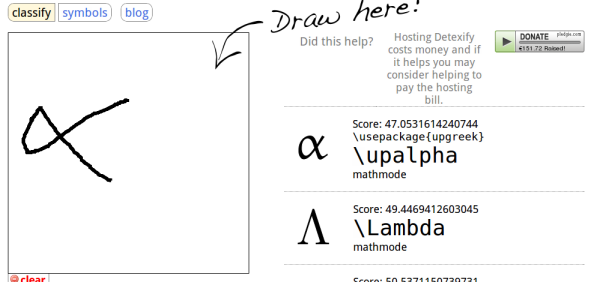
Posted in FOSS, Hacks, Web 2.0, Writing | 2 Comments » | 7005 views
June 12th, 2010 by jose
I just found this presentation, and thought it’s worth bringing it to the attention of ap.com readers:
Anita de Waard is the director of Disruptive Technologies at Elsevier. A company that has a position with such a name has my sympathy. Looks like publishers are slowly realizing that they can have a huge impact on how science is done, and how fast it moves, if they simply paid more attention to modern trends.
Only habit prevents us researchers from realizing that the media we use the most, a paper article with a review cycle of years, is woefully wrong in this day and age.
A somewhat related idea are the 5 stars of open linked data:
★ make your stuff available on the web (whatever format)
★★ make it available as structured data (e.g. excel instead of image scan of a table)
★★★ non-proprietary format (e.g. csv instead of excel)
★★★★ use URLs to identify things, so that people can point at your stuff
★★★★★ link your data to other people’s data to provide context
If scientists and publishers have opendata in mind (and the trend is there!) doing research becomes more fun immediately (no more mails to the authors asking for data that get no response). Seeing that the academic publishing industry has at least one person (Anita) that gets it makes me feel good. Looks like Elsevier has a head-start.
Posted in Early-adopter, Hacks, Opinion, Social Media | 6 Comments » | 7583 views
May 13th, 2010 by dario
 Project SOAP (Study of Open Access Publishing) is a two-year project, funded by the European Commission under FP7. The project is currently running a survey to understand the perception of Open Access publishing in the academic/research community. You can participate in the survey by following this link. Participants sharing their email address for further collaboration with the project automatically enter a prize draw for an Apple iPad.
Posted in Surveys, Writing | 5 Comments » | 5304 views
May 7th, 2010 by Roberto
 “Incrementing productivity” is oftentimes framed in terms of incentives. The simpler incentives are, of course, monetary incentives. Academia is in this respect not so different from the business world – or so think many university managers and administrators. Some well endowed universities pay a premium to productive researchers: for instance, €3,000 for an article in an A+ journal, or maybe a lighter teaching load. The intrinsic value of discovery, and the thrills of fame, are no longer or not only the principal movers for scientific production. Not everyone agrees.
Read the rest of this entry »
Posted in Time management, Writing | 3 Comments » | 6551 views
