Archive for category: Reading

SciSurfer: real-time search on journal articles

May 5th, 2010 by jose

Imagine a world where real-time search is the norm. You will get just the information you seek landing on your lap the exact minute it becomes available, without you having to explicitly search for it. Will this change the way you do science? SciSurfer thinks it will.

The release cycle of scientific knowledge is slow. It may take up to 2 years for a paper to get accepted in a journal. The publishing process in itself will add a buffer of a few months (arguably because of the time cost of having a paper edition, even though most people will never use it). So, for some of us, it doesn’t feel like we are missing much if we do not get the latest updates on our field the very same minute they are published. Just going to conferences yearly feels like more than enough. But there is a portion of the academia that needs constant updates on their field, as close to real-time as possible. If you are in the life sciences, getting the latest paper about a molecule or a gene you work on before your competitor does may make or break your career.

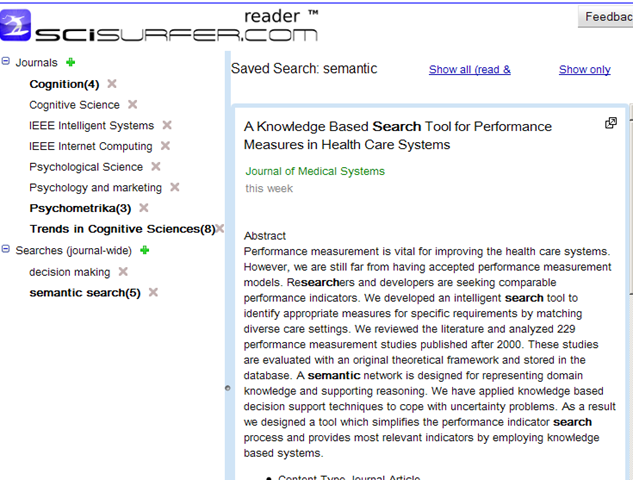
For those academics, sciSurfer may be a very valuable tool. The basic idea of sciSurfer is to integrate all journal feeds and search over them. Note that they do not archive RSS, so only the latest articles are available. This is a different way to think about search, closer to twitter’s than to Google’s.

image 

(more…)

LaTeX rendering of equations in Google Wave – LaTeXy

November 2nd, 2009 by jose

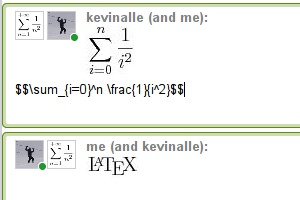
It was a matter of time before someone wrote a robot thatwaveLatexy-images grabbed latex  and returned an image after latex processing. LaTeXy does exactly that and has just increased tenfold the usefulness of wave for academics.

AutoVer (windows) gives you easy versioning

October 27th, 2009 by jose

About two years ago we talked about filehamster. It was  screen-composite-smfree, unobtrusive, and simpler than doing version control ‘by hand’ (adding numbers to filenames) or ‘by machine’ (using a proper versioning tool such as subversion or mercurial).

Well, since then filehamster has moved on to be a pain in the ass. Now the free version nags you a lot, and the paid versions are not really giving us any outstanding features. Plus as a .NET application, it eats up RAM.

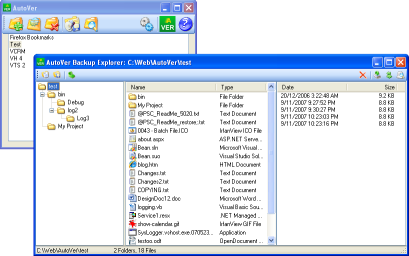
Enter AutoVer. Completely freeware, no nags, and a much better interface to boot. The GUI and options make more sense too. I even use it for coding when I’m doing something small and a mercurial repo would be overkill.

Eventually, all writing applications should enable smooth versioning and real-time collaboration (Office 2010 beta does! Wave and etherpad are not alone anymore). The slider that controls versioning as in a time machine is fantastic. AutoVer would not give you that. The AutoVer model also breaks when you send the manuscript to a collaborator, and he edits it on his machine (often changing the file name). Still, it’s much better than not doing versioning at all or doing it by hand.

By the way, does anyone know an alternative that is cross-platform?

What’s Wrong with Probability Notation?

October 22nd, 2009 by jose

Sometimes I wonder why many humans (me included) have trouble understanding probability. In cognitive science, probabilistic models are taking over most areas. Still, most people struggle with them. Could it be that the notation is just hard to swallow? What’s Wrong with Probability Notation? is a magnificent post that gives some basic reasons:

The first two issues arise in the usual expression of the first step of Bayes’s rule,

p(x|y) = p(y|x)p(x) / p(y),

where each of the four uses of p() corresponds to a different probability function! In computer science, we’re used to using names to distinguish functions. So f(x) and f(y) are the same function f applied to different arguments. In probability notation, p(x) and p(y) are different probability functions, picked out by their arguments.

This is one clear communication problem. Ideally we want more people to follow probabilistic reasoning. Doctors, judges, etc all show significant struggles when given probabilities (see e.g., Helping Doctors and Patients Make Sense of Health Statistics).

But how do we tackle this problem? Changing notation is easier said than done. In fact, anyone departing from traditional notation will have to convince reviewers that his notation is better… and add to the risk of cause a less-than-ideal impression.

Any ideas?

AcaWiki: a wiki that encourages academics to write their stuff for the general public

October 8th, 2009 by jose

AcaWiki is a new wiki aimed at academics. They are asking for summaries of academic research. This could be an excellent exercise for students (i.e., don’t hand me your paper: post it to acaWiki, and let me know when I can look at it).

From reading the FAQ, It’s not clear to me that they are selling it right to the academic community:

What does AcaWiki offer to academic researchers?

AcaWiki offers a web 2.0 way of interacting with the public to increase impact. Research often languishes in academic journals, perhaps read only a few times by infrequent visitors. AcaWiki allows scholars to increase the impact of their research by enabling them to share summaries, long abstracts and literature reviews of their peer-reviewed work online. AcaWiki also encourages discussion by providing a talk page for each research paper.

Hmm, meh. While these are interesting reasons, I doubt academics will rush to fill in summaries. Discussion is covered by reference management sites such as citeUlike. And, of course, to make this work for academics, contributions to acaWiki must be well-evaluated by hiring committees… which is not going to happen any time soon. When faced when the decision of adding one more line to their CV or dedicating a similar stretch of time doing summaries of their articles for acaWiki, what would most academics do?

I still think this could fill a nice niche for student homework. Instead of leaving their work hidden in the HD of their T.A., posting it to acaWiki could be of use to the community. I often have to reread a paper because I’ve forgot most about it, and a good, crowd-refined summary would definitely help.